
The House of Common Ground: organisations and individuals united on safety by design principles
FlippGen is pleased to have signed up to and be actively supporting the Joint Statement of Principles for Furthering the Protection of Children Online.
The joint statement (which is available in full at the bottom of this webpage) sets out a shared framework for ensuring social media platforms, and other digital services, are designed with children’s wellbeing in mind and for strengthening the role of government in making online environments safer. It has already gained the support of over 30 organisations, and 30 individuals.
As young people, we developed FlippGen’s ‘For Us’ campaign last summer. It was clear then, and remains clear today, that young people want online platforms that are safe by design and age appropriate. Our ‘For Us’ manifesto explicitly calls for a prohibition on addictive design for under-16s. We believe that the onus and burden should be put on platforms, rather than young people or parents.
This joint set of principles represent a significant step forward. What, on the surface, appeared to be a divergence of views, and was pitched in the media as ‘pro-ban vs anti-ban’, has now reached a broad consensus. The signatories to the principles include organisations and individuals from across the spectrum of opinion: FlippGen, Health Professionals for Safer Screens, Mumsnet, Parentkind, NSPCC, 5 Rights Foundation, Professor Sonia Livingstone OBE, many bereaved parents, and even Lord Nash himself.
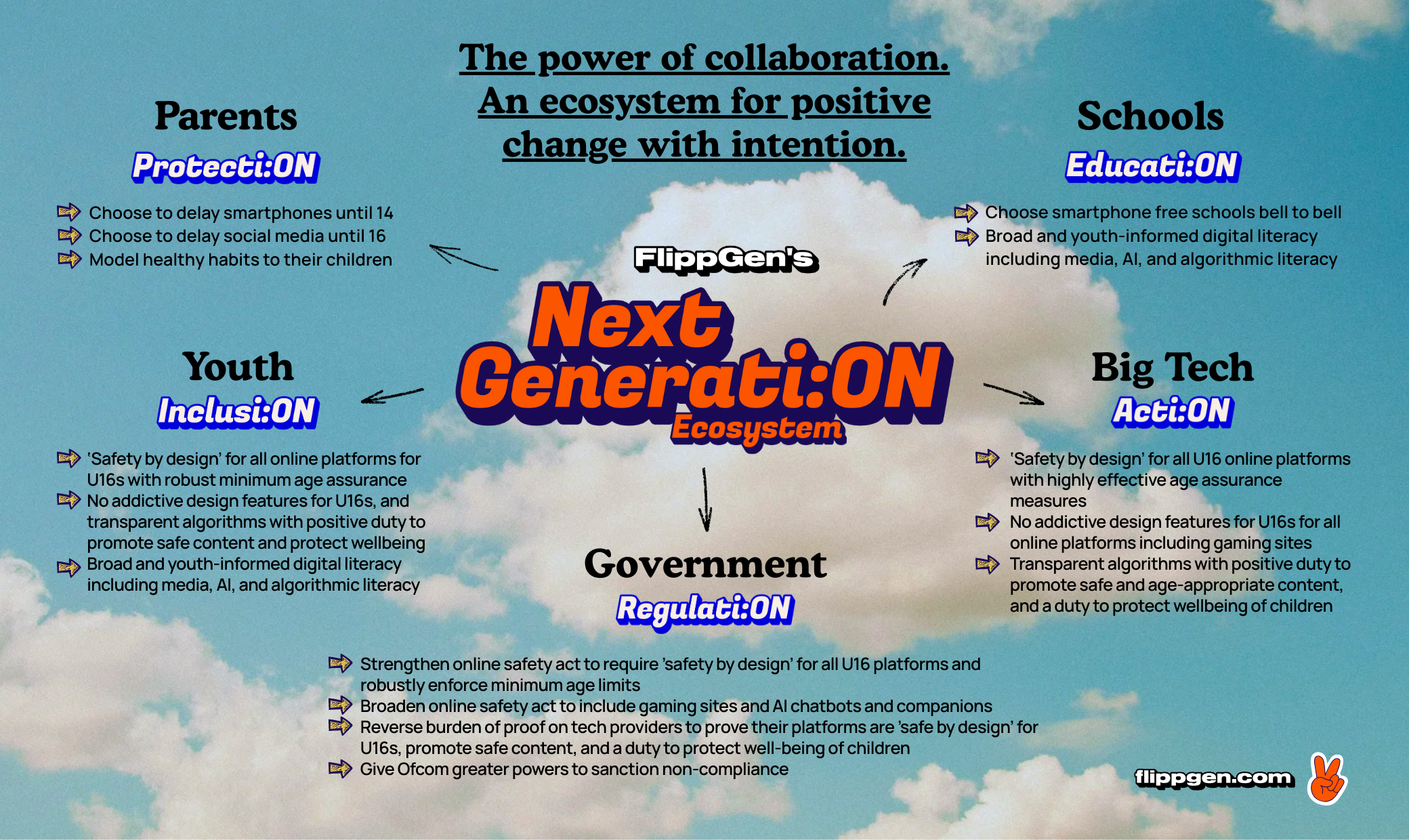
FlippGen’s ecosystem of change
This joint statement rectifies two key issues within the debate about how to keep young people safe online. In the previously framed ‘under 16’s social media ban debate’, we were missing two vital things:
Framing the issue as ban vs no ban was simply reinforcing people operating in silos, and working in isolation.
Instead we should have been asking, “Do we want the current status quo to change?” The overwhelming answer is clearly yes.
The joint statement of principles addresses this. The 10 proposals set out to move the debate beyond a simple question of whether social media should be banned for under-16s, and towards a bolder and braver question, of how we can actually keep young people safe online. In doing so, it has brought organisations and individuals which were previously polarised together.
FlippGen believes in the power of collaboration. An ecosystem for positive change with intention; where parents, schools, and the government work together, and youth voices are included in the conversation.
Under all previous policy proposals there was agreement on one key point: the current main social media platforms as designed should be restricted for U16s. It has always been clear that there was agreement on 80%, whilst organisations disagreed on 20%. These principles represent a shift of focus from that 20%, to the 80%.
What do the principles call for?
The Joint Statement outlines a set of measures designed to reduce preventable harm. These include:
Platforms and digital services that cannot meet minimum safety standards should not be allowed access to children.
Addictive and persuasive design features (such as infinite scrolling and autoplay) should be addressed.
Risky features (such as stranger contact, location tracking, and risky AI features) should also be addressed.
Gaming platforms and emerging AI technologies must be covered alongside social media.
Platforms should remain responsible for children’s safety even where young people try to circumnavigate or workaround restrictions.
Children’s voices should inform future safeguards and digital policies.
Stronger public messaging should help families understand online risks.
Digital literacy should support children online as they grow older.
Independent oversight should monitor how platforms respond to risks.
In particular, the Joint Principles recognise “messaging should not refer to ‘banning’ children from services, or to blanket bans, and should instead focus on safe design as a baseline condition for services to be able to access children and young people as users”.
Next steps
As an organisation, we will continue to work to ensure that platforms are made safe by design as a default, with a particular focus on addictive or persuasive design features, and other risky features or functions. This includes leading a coalition of over 30 organisations to campaign for safety by design through the ‘For Us’ coalition: www.forus.org.uk
We are also working closely with DSIT to ensure that young people’s voices are at the heart of the national conversations around the social media consultation. We are hosting a Youth Town Hall on the 23rd April, bringing together young people from across the country to feed back on the Government consultation.
Resource: Joint principles and signatories in full.
